 Save this storySave this story
March 2026 was poised to be perhaps the pinnacle of Utah Mormon cultural influence. The fourth season of the Hulu sensation The Secret Lives of Mormon Wives was dropping 10 new episodes of soft waves, plump lips, and perky breasts. And just 10 days later, the latest season of The Bachelorette would premiere on ABC with a Mormon woman—Taylor Frankie Paul, a cast member of SLOMW—at its center for the first time. But last week, what may have been cracks in the picture-perfect presentation of this demographic of Utah women became a major fissure when a 2023 video of Paul throwing metal barstools at her ex-partner, Dakota Mortenson, while her child is in the room surfaced online. Just three days before it was set to premiere, The Bachelorette—at a likely cost of tens of millions of dollars—was entirely cancelled. There are reports from cast members that the filming of season five of SLOMW has been paused. (As of press time, Hulu had not replied to a request for comment.)
Over the last decade, the cultural currency of the Church of Jesus Christ of Latter-day Saints (LDS) has risen sharply in the United States, as the Mormon lifestyle bloggers of the 2010s laid the groundwork for the reality show influencers of today. Those young content creators—with their long, shiny hair, mostly modest attire, affiliate links, and several children under five—walked so Paul and her #MomTok compatriots could run (perhaps a little too far). Is this month’s turmoil an indication that the Mormon commerce machine may come to its inevitable end? Or will it now morph once again?
A few weeks ago, I flew to Salt Lake City to report on the powerful 2.0 wave of Utahn beauty influence—timed perfectly to this Big Month for Mormons. I sat down with the cast of SLOMW (minus Paul, who pulled out the day before, and Whitney Leavitt, who is currently performing on Broadway as Roxie Hart in Chicago), visited the med spa of The Real Housewives of Salt Lake City’s Heather Gay, got Utah Curls, and slurped on a “dirty soda.” This is what I found along Interstate 15—and where I think this aesthetic subculture-turned-juggernaut is headed next.
I've only been in Jessi Draper’s chair for four minutes when she starts telling me about her labiaplasty. “After having a baby, I was like, it's not the same down there. It was hard to wear yoga pants. It was just distracting,” the 33-year-old hairstylist says while twirling a lock of my hair into her signature—and, since 2024, trademarked—“Utah Curls” style. The inner (or, in this case, outer) workings of their genitals may be TMI for the average chat with your hairstylist, but for Draper, this is small talk. In fact, she’s told this story before, on the first season of Hulu’s megahit reality show The Secret Lives of Mormon Wives. (Hulu doesn’t release its numbers, but there are rumors that ratings have topped that of The Kardashians.) Getting a labiaplasty—or breast implants, Botox injections, spray tans, or lash extensions—is par for the course in Utah Mormon beauty culture.
We’re in JZ Styles, a 15,000-square-foot beauty behemoth that Draper founded in 2016 alongside her father. The salon is nestled in the Pleasant Grove suburb of Salt Lake City, just down the road from one of the town’s Swig locations, the “dirty soda” shop that skyrocketed to nationwide fame after the show’s premiere. (Mormon doctrine forbids alcohol consumption; it takes no issue, however, with drinking a blend of Diet Coke, flavored syrup, and half-and-half.) This area, which is home to utopian-sounding towns like Thanksgiving Point and American Fork, has more plastic surgeons per capita than Los Angeles, according to a 2017 report published by the Utah Women & Leadership Project. Utah also has more members of the Church of Jesus Christ of Latter-day Saints (LDS) than, well, anywhere else in the United States; approximately 42% of the state’s population identifies as Mormon.
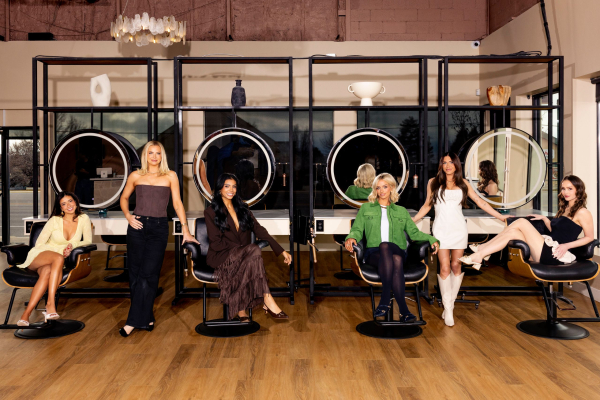
Along with the salon, the building is home to a warehouse—where the SLOMW production company rents out space to shoot the cast’s confessionals—and a store that sells walls of hair extensions, styling products, accessories, and merch, including sweatshirts with words like SAINT, SINNER, and FAME WHORE emblazoned on them. There’s also a crewneck that says BAD AT HAIR, a reference to drama Draper had with costars Taylor Frankie Paul, 31, and Demi Engemenn, 31, during season two of the show, when Engemenn allegedly advised Paul to stop seeing Draper for her extensions because she was "bad at hair." Utah Curls is printed on the packaging for Draper’s beige and pink curling irons, which come in three sizes. (She tells me they sold out in less than 24 hours following season one’s premiere.) In the same space is a hair school called JZ Academy. Draper currently has around 50 employees who help her run the place (including her sisters, who serve as the heads of operations, and her mom, who is also a hairstylist, as lead educator). And even though I’m there at 12 p.m., on a random Tuesday in March, six of the salon’s other chairs are filled by young women. All of them are getting blonde highlights.
ArrowArrow
Even if you haven’t seen The Secret Lives of Mormon Wives, you probably know a “Mormon wife” when you see one. If the original, modern LDS stereotype was conservative young men in white shirts and black ties (if you’re not one of the millions who saw The Book of Mormon, you know the image), today’s aesthetic vision of Mormonism is quite the opposite. “You can tell when a girl's from Utah,” Draper tells me. There’s “a lot of blonde bitches here,” her costar Mikayla Matthews, 25, says later, as we sit in the back office of JZ Styles with Draper and costar Mayci Neeley, 31. LDS members pioneered the settlement of this state, and Utahns, whether they’re Mormon or not, are heavily influenced by the religion’s culture; the restaurant inside my hotel in downtown Salt Lake City was not serving alcohol, for example. The show’s cast of women, who at some point have all been members of the church, are mostly white with long hair, microbladed eyebrows, Juvéderm-filled lips, and, quite often, pregnant bodies—there are, at the time of publication, 23 children between the seven cast members (we’re not counting Engemenn, who is no longer filming the show).
Over the sounds of a few high-powered hair dryers, six of the show’s current cast members tell me that the area’s obsession with aesthetics isn’t just an overblown media headline. I believe them since I’ve now seen the infamous aesthetics-focused billboards that line Interstate 15, the major highway that cuts through Utah County, with my own two eyes—they advertise for plastic surgeons, med spas, teeth whitening services, hair extensions, and even Draper’s salon. “I think that if people assume that this is a vain state, they would be correct,” says costar Layla Taylor, 25.
Each of the SLOMW cast members has spoken openly about their aesthetic work, ranging from neuromodulators to breast implants to the aforementioned labiaplasty. After filming season one, Taylor gifted herself a breast augmentation, rhinoplasty, a tummy tuck, Botox, and filler in her lips, chin, and jaw. “I had kids young, and I love my babies to death, but they screwed up my body, and I wanted to feel hot again,” she said on Page Six’s Virtual Reali-Tea podcast at the time. “I’m single. I want a new husband one day, so I had to revamp!”
Some of them have documented their experiences on camera—both for the show and for their personal social media. In 2022, Taylor Frankie Paul, the fallen Bachelorette, made the women’s “MomTok” group famous for outing her swinging scandal. In season four, which premiered earlier this month, she gets a breast augmentation. It’s her second in less than four years. I was scheduled to interview Paul at JZ Styles, but the day before I arrived, I was told she would no longer be there. We didn’t get a chance to discuss her revision—or anything else. During a confessional interview, she said she wanted to get a “touch-up” after having another child and also for her upcoming appearance as the lead on The Bachelorette. “I think I’m about to be in a lot of dresses,” she says. “If you know me, I’m not normally in dresses, so I just kind of want to feel good in them.”
For the stars of SLOMW, telling the world about where and what on their bodies they’ve had poked and prodded feels natural. Like their moral obligation, even. “We're not pushing for people to get plastic surgery,” Matthews says. “It's just like, ‘Hey, if this is something you want to do, there's no shame, there's no judgment. This is my experience for your information, for your knowledge.’”
“That's how it should be,” adds Neeley. “You see certain celebrities and [they say], ‘I've never done anything.’ I think that's why we like to be open about it too, because I'm like, it's so weird to act like you are perfect. We know we're not.”
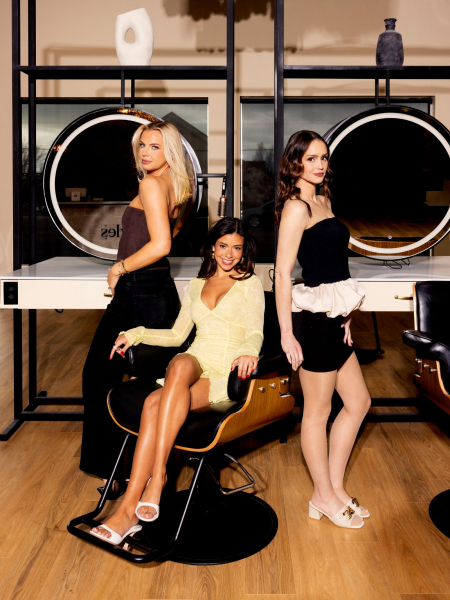
Neeley, Affleck, and Matthews at JZ Styles, the birthplace of Utah Curls.
When Allure traveled to Utah in 2017 to investigate that earlier phenomenon of LDS influence, we learned that while there’s no Mormon doctrine that outright says, “thou shalt be hot,” there are messages regarding a woman’s appearance that filter through the church. The LDS website even has a section on “Dress and Appearance” for its young missionaries. “From a young age, we’re taught that our bodies are sacred temples where we make covenants with God. It’s about self-confidence from the inside out. Inner beauty is really important, too,” Dancing with the Stars cast member (and erstwhile blogger) Witney Carson told writer Alice Gregory at the time.
“It's said that the harder you work as a missionary, the hotter your wife."
Some are a bit less eloquent than Carson in addressing the value that the religion can put on appearance, particularly that of a woman: “It's said that the harder you work as a missionary, the hotter your wife,” says Julie de Azevedo, PhD, a Salt Lake City–based psychotherapist specializing in Mormon women’s emotional health and relationships. “They joke about it, but I think there's truth in jest.” The misogyny isn’t exactly whispered among Mormon men. It’s often said out loud. And recorded. And published on the internet. In 2015, Elder M. Russell Ballard, a prominent member of the LDS faith, who served as president of the Quorum of the Twelve Apostles from 2018 until his death in 2023, gave a devotional where he suggested to women that they "don't wander around looking like men. Put on a little lipstick now and then and look a little charming. It's that simple.” There are plenty of other sexist incidents and similar messages that’ve been repeated throughout the church’s recorded history, including a 1994 sermon by former church president David O. McKay in which he encouraged women to wear makeup, declaring “even a barn looks better when it's painted.” It’s not hard to imagine what’s said behind closed doors.
You don’t need to be exceptionally pious to be affected by the Mormon way of life. In fact, the cast says the church’s influence is very much embedded in their psyches, even though not all of the Wives are devout followers of the religion. It makes sense, since being part of the LDS faith affects every aspect of a churchgoer’s life: what they wear, what they drink, whom they marry, and how they spend their time. Many have vocally left the church, including Taylor, Matthews, Draper, and their costar Miranda Hope, 27. Jen Affleck, 26, tells me she’s currently going through a “faith crisis” and is unsure of where she stands, although a few days after our chat, she vlogged herself attending church. Neeley tells me she’s still very much a practicing Mormon. Paul and costar Whitney Leavitt, 32, still attend church. “If you've ever deconstructed a high-demand religion, it is so much more than just going through the faith crisis alone and coming out on the other side,” Hope says. “There are so many things I'm so grateful for that the church taught me and that I still practice today, but at the same time, there are still things that I find I [need to] work through.”
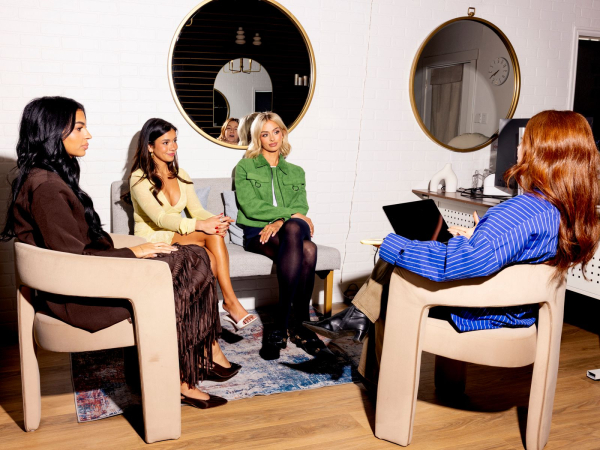
From left: Taylor, Affleck, and Hope were quick to admit that the aesthetic stereotypes of Utahns are exactly what the billboards lining Interstate 15 would lead one to believe.
Even if they’re not the devout Mormons who wear sacred garments and stay virgins until marriage, to outsiders the cast has become unofficial spokeswomen for the faith, or at least the culture. This is, in part, by design: Dr. de Azevedo says there’s a saying that “every member [is] a missionary," which is the idea that “you shine your light and other people will want to be Mormons.”
Katie Ludlow Rich, a scholar specializing in Mormon women’s history, tells me that post-World War II, there was a movement within the church to assimilate into the broader American culture. “In the bigger push toward missionary work, there seems to be a stronger emphasis placed on appearance, not only those spiritual imperatives of attracting a mate,” she says. “You are a missionary. Everywhere you go, you represent the church, and so you have to look a particular way in order to represent the church well.” Because who wouldn’t want to join a religion seemingly spitting out beautiful women?
A recent survey published by two researchers at Brigham Young University (LDS’s higher-education center, and where many young Mormons meet their future mate) found that 14% of the 1,333 Latter-day Saints surveyed (82% of whom were women) have had major cosmetic surgery and 20% had undergone cosmetic enhancements, which, beyond Botox, include treatments such as laser hair removal, chemical peels, and dermabrasion. These numbers, the researchers say, are significantly higher than the national average (according to Pew Research Center, only 4% of Americans report having had cosmetic surgery). Still, 10 years ago, plastic surgery was far more secretive even among members of the LDS community. “Now it's like, I want everyone to know that I am invested in self-care, that I can afford it, that I am going to the coolest place in town, and that I own what I want and I get it,” says Heather Gay, owner of Beauty Lab + Laser, a med spa based in the Utah capital. (She, too, has purchased billboards on Interstate 15, including one two years ago that encouraged passersby to “Love thy selfie.”)
Gay is also a cast member of The Real Housewives of Salt Lake City, another successful reality show franchise that lifts the curtain on Utahn Mormon culture (three cast members are ex-Mormons, while one is still practicing). She left the church nine years ago, in her early 40s, and has since publicly distanced herself from the faith. Her book, Bad Mormon, and the Peacock limited series, Surviving Mormonism with Heather Gay, both explore the psychological impact of LDS culture.
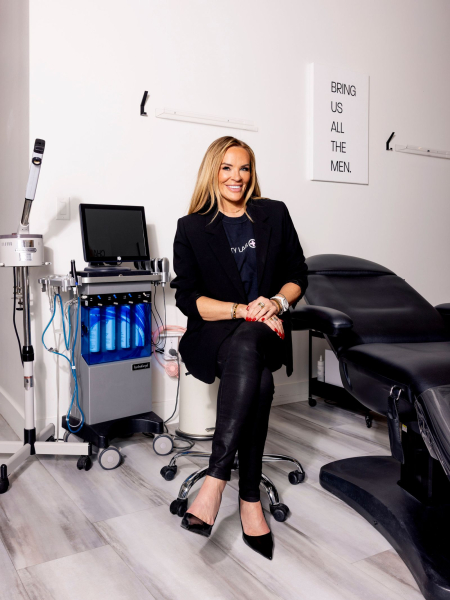
RHOSLC star Heather Gay now runs two Beauty Lab + Laser locations in the Salt Lake City area.
The constant nipping and tucking might seem at odds with a religion that preaches modesty and a sacred text that advises parishioners to abstain from consuming alcohol, tobacco, drugs, and caffeine, and declares that tattoos and piercings don’t show “respect toward our earthly bodies.” But Mormonism is a high-demand, patriarchal religion, and the church’s obsession with godly worthiness has only made the fixation on beauty flourish. “There's a scripture that says, ‘Be therefore perfect,’ and I think that's misinterpreted as, ‘be externally flawless,’” says Dr. de Azevedo. “There's kind of this cultural belief in Utah that if you look perfect—if your kids look perfect, if your house is perfect—then somehow it's tied to your righteousness.” As Brigham Young, the second president of the LDS church, told the early Utah settlers in the mid-1800s: “Beautify your gardens, your houses, your farms; beautify the city. This will make us happy and produce plenty.” In other words: Appearance matters.
“There's a scripture that says, ‘Be therefore perfect,’ and I think that's misinterpreted as, ‘be externally flawless.'"
It makes sense, then, why these women put so much time and effort into their outward presentation. “Women are encouraged to be stay-at-home moms, so if you don't have other ways to find satisfaction and value, you might focus more on appearance as something you can control or something that you can make you feel good about yourself, because you're not achieving outside of the home as much,” Dr. de Azevedo says.
“There are these spiritual imperatives that are placed on [Mormon women] to look a particular way in order to attract a husband,” Rich says. Marriage is not a choice. Here, it’s necessary for salvation. “You can't be with your family for eternity in LDS theology unless you are married and sealed for time and eternity in the eldest temple,” says Rich. “To return to heaven or to have an eternal family, that requires marriage.”
But there are twice as many single women as there are men in the LDS faith, making finding a suitable husband to marry and have babies with yet another competition. And most Mormons don’t risk waiting: The average age of marriage is 28.5 for men and 26.8 for women, according to a 2023 devotional given by the church’s current president, Dallin H. Oaks. The SLOMW cast members were all married for the first time between the ages of 17 and 23. “There is pressure to get married, and when you're finding your significant other, you obviously want to attract the right person,” Affleck tells me. “So what do you do? You do all the right things.”
The one-upmanship continues even beyond marriage. Rich tells me that she knows of an 88-year-old lifelong Mormon woman living in Boston who goes to weekly lash appointments. “She lives in an upper-middle-class neighborhood in Boston where there are lots of professional women, and she said, ‘None of them go get their eyelashes done. But when I go to church, most women have their eyelashes done,’” Rich says. “And that's a woman in her 80s, feeling this pressure.”
“It's a performative faith,” says Gay. "You're Mormon as much by the things you believe as by the things you do and don't do. It's like, ‘Oh, are you getting your lips done? I'm getting my lips done. Are you getting Botox? I'm getting Botox.’ You are constantly checking yourself against your neighbor.” Hope, who left the church following her own faith crisis around the time season one began filming, agrees: “I think we've all heard the term ‘keeping up with the Joneses,’ and I think that's very prevalent in Utah,” she says.
Researchers have found that this kind of environment can create something known as a "contagion effect,” in which attitudes or behaviors can spread throughout a specific population. This phenomenon has also been reported in places like South Korea and in Orthodox Jewish communities, where there is ethnic homogeneity—and an outsized number of plastic surgery patients. The pursuit of perfection, in this case, is also tied to proximity to whiteness. “Everyone's blonde and blue-eyed here,” Affleck, whose mother is Ecuadorian, says. “Being different, we just stand out, and that can cause a lot of insecurities. I mean, I've been guilty of dyeing my hair blonde for that exact reason.” Utah County is 89.2% white, and the LDS faith globally is 72% white.
ArrowArrow
Taylor says that being the only Black cast member on SLOMW is still an everyday struggle. “For a long time, I thought the perception of beauty was long, straight hair, light-colored eyes, skin that wasn't dark like mine,” she tells me. “I tried to bleach my skin one time, and I straightened my hair my whole entire life and have done things that were very toxic because I thought that that's what beauty was because it's all I saw growing up.” While this is in part because of the homogeneity of the region, racism is also embedded into the very fabric of the religion: Earlier versions of the Book of Mormon contained a passage that described dark skin as a curse from God (it’s since been revised to contain less harsh language, says Rich), and until 1978, the LDS faith did not allow Black men to become priests. Today, the church has a statement on its website saying it “condemns racial and cultural prejudice in any form.”
While she says she’s filtered herself in past seasons, Taylor has since learned to show up as her authentic self. Part of that transformation was inspired by finding a Black hairstylist who understands how to work with her hair texture. “I've had braids now. I've worn wigs now, and it's been so cool to fully embrace that side of myself,” Taylor says. “For a long time, I felt like I wasn't safe to do so.” She had been getting her hair done at JZ Styles, including extensions, but stopped in season three due to the damage caused by the employees’ lack of experience working on Black women’s hair. Now, Draper says she’s working with Taylor’s stylist on a curriculum for JZ Academy. “I just think it's important to kind of expand what you know,” she tells me while I’m in her chair. “Even though Utah's predominantly white, it's good to know everything. I never want to be in that situation again.”
The night before I was set to interview the SLOMW cast, I strolled through downtown Salt Lake City in the rain looking for a spot to get a manicure. I didn’t have any trouble finding a suitable place steps away from Temple Square—the area known as the historical and spiritual center of the LDS church. Three young women had also braved the downpour to get pedicures, and they sat side-by-side in their Utah best: matching sweatsuits and highlighted beachy waves. Each of them opted for the same pinky-nude polish on their toes. The topic of discussion was fake tanning, and they were listing the pros and cons of their two favorite brands: Glowing Tan and St. Tropez. Two of them were wearing engagement rings. They appeared to be college-age.
My fellow nail salon-goers were the portrait of the SLOMW season one version of Mormon beauty, but I’d argue the cast today represents Mormon beauty 2.0. So, what’s the 2026 version of a Utah Curl? “It’s all about the blowout,” Affleck says, her dark hair blown out smooth and sleek with soft flips that emphasized her layers. Draper adds that her clients are ditching the stereotypical “long, long, long hair” and requesting shorter, more natural hairstyles and colors. Only two of the eight wives this season are blonde, a stark difference from season one, wherein all but one had highlights, lightened hair, or full-on bleach jobs. Taylor says she hasn’t had lash extensions in years. Matthews took out her breast implants in 2024, although it was more because she believed they contributed to her chronic eczema flare-ups than for aesthetic reasons. Gay also sees the aesthetic goals of her Beauty Lab + Laser clients evolving: Instead of puffing up their faces with filler, they’ve become more interested in microneedling and lasers, which Draper and Hope also say are now part of their beauty routines. “Everyone wants really glowy, really tight, glazed donut skin,” Gay says. (Allure has previously reported on the safety concerns regarding med spas, so please proceed with caution.)
The new definition of Mormon perfection looks different now, but that’s not to say the pursuit of looking naturally beautiful is easier than looking artificially enhanced. After Draper releases one final Utah Curl into my hair (I now match the six other clients in the salon), she tells me she regrets her most recent cosmetic surgeries, which included an upper and lower blepharoplasty, a procedure that involves removing excess skin around the eyes, along with fat grafting in her face. She says she got caught up in “it,” and I assume she means the quest for flawlessness. “I went in for one thing, and I was talked into doing other things,” she explains. “It can be really easy to get talked into things because we're, again, in Utah Mormon culture, and the standard of beauty is so high, and we're also on TV.”
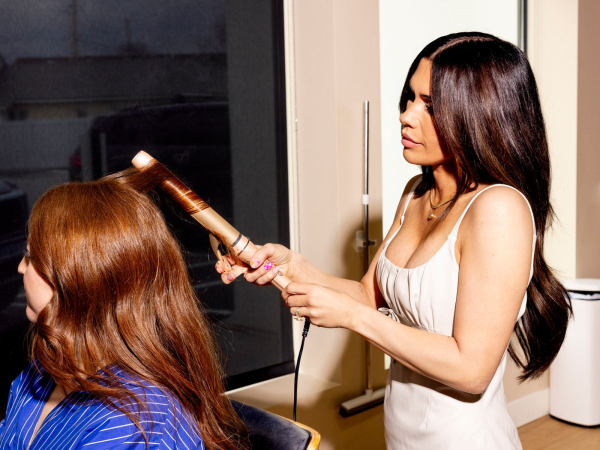
Draper uses a curling iron from her own line to create her trademark—literally—style of ringlets, called Utah Curls.
A few days after our chat, Draper shared a video to her 1.6 million Instagram followers, addressing the negative comments from strangers about her appearance. She revealed that she got Kybella injections in hopes of reversing the effects of the fat grafting in her face. “I have such self-confidence issues, and looking back, I can totally see how I was blinded by those,” she says. “I was beautiful, and I wasn’t able to say that a few months ago, and I can say that now.”
“Appearance is everything here,” Taylor reiterates. She’s been open about her ongoing eating disorder throughout the show, and during the final episode of season four, she tells Hope and Draper that she’s been abusing Tirzepatide, a GLP-1. “I got it from a plastic surgeon here in Utah in the fall of last year,” she tells me. “They just handed it to me without ever having an appointment with me. They got me a prescription, and it was at my house the next day.” She stopped using it a couple of months ago. “I'm very happy that I shared that with the world because there are so many people that abuse this drug and it's so easily accessible now,” she says.
“I have no interest in changing myself… I mean, I have a boob job, I get Botox."
Two years ago, Hope seriously considered getting her ears pinned back. “They stick out more than I would like,” she admitted, although she says it never really bothered her until she received comments about it online. She’s since changed her mind. “I remember looking back at baby pictures of my son and even now, he has my ears exactly, and I was like, ‘I'm not doing that anymore," she says. “I have no interest in changing myself… I mean, I have a boob job, I get Botox. I'm still open to doing that stuff. However, I think being very intentional with it is important.”
With a 40-ounce #MomTok-branded Hydrojug weighing my bag down, I left JZ Styles to tag along with Hope for a visit to Rise Rejuvenation, a med spa just 20 minutes north that’s frequented by the cast. (The American Med Spa Association estimates that there are 225 med spas in Salt Lake City and another 125 in Utah County, where Rise is located.) Season one’s most memorable scene includes Neeley, Leavitt, and Matthews at the practice, inhaling laughing gas in what they describe as a Mormon loophole to get “high” without drugs. When I ask Hope if she ingests the stuff every time she visits the med spa, she laughs and says only sometimes: “I will just for kicks and gigs, but normally I don't do it when I get my Botox done.” Besides getting neuromodulators in her forehead, eleven lines, and lips, Hope often gets HydraFacials at Rise and is interested in getting a Moxi treatment, a non-ablative resurfacing laser. She says she’ll just have to wait until there’s enough downtime between filming to fully recover.
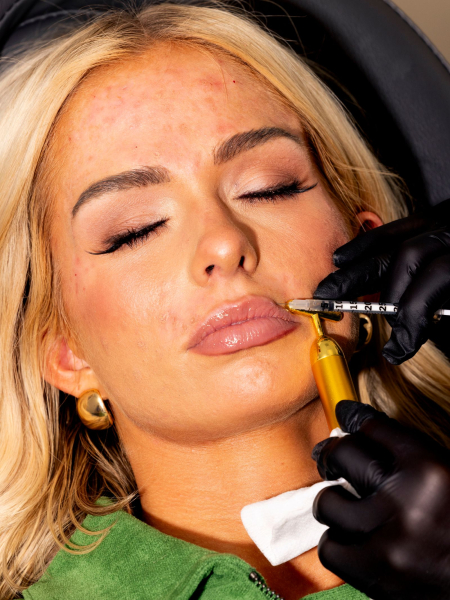
Hope gets Botox in her forehead, eleven lines, and lips.
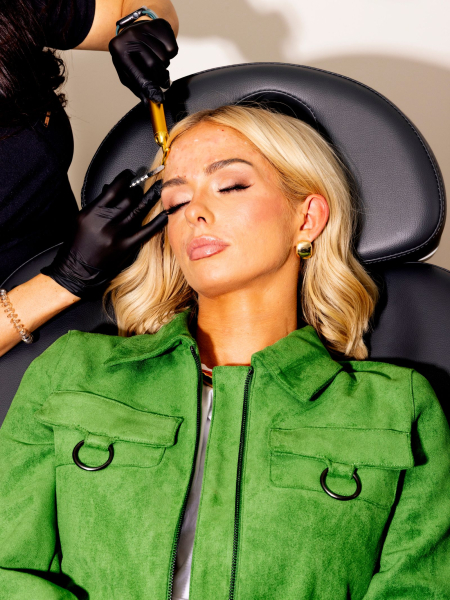
After Hope’s appointment, I head back to downtown Salt Lake City with my head of Utah Curls to walk around the 10-acre campus that’s home to the Salt Lake Temple (a modest footprint, really, when you consider that the church is the nation's fifth-largest private landowner and owns 1.7 million acres across America). The area is eerily quiet at 5:30 p.m. A few women pushing strollers walk past me with similar-looking ringlets in their hair, although their eyes look far more tired than mine. I approach the 222-foot-tall temple looming in the center of the campus, but I can’t get too close: It’s currently undergoing an aesthetic upgrade of its own, set to be completed late this year.
“Hello!” I hear from behind me. I turn to see two modestly dressed, blue-eyed young missionaries approaching me—a blonde sporting a messy low bun and a brunette with undone waves. There isn’t a hair or lash extension in sight. “I love your hair,” the blonde tells me, gesturing to my curls. “Do you want to learn about what goes on in the Temple?”